is syllable division confusing and frustrating for your child?
How does Art of reading teach syllable division?
The Art of reading teaches syllable division based on cadence of speech.
let's start with a definition
a Syllable is:
A unit of pronunciation having one vowel sound and forming all or part of a word.
So why have we been using vowel length instead of pronunciation to determine the boundaries?
This is where all the inconsistencies and exceptions stem from.
Why does Art of Reading teach syllable division differently?
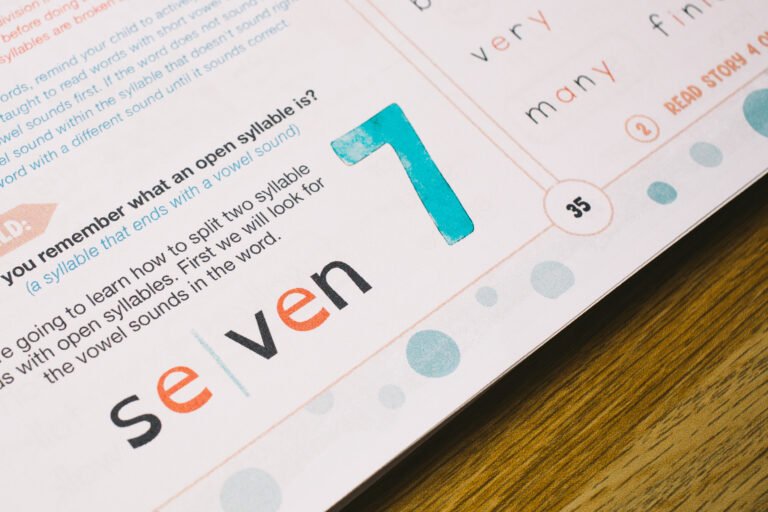
Using vowel length as a determining factor for syllable boundaries (as is the current mainstream convention) is confusing and frustrating.
A lot of 1st and 2nd graders struggle with syllable division because the way we’ve been teaching it has too many exceptions, contradictions, and rules that don’t make logical sense.
The deeper you look into it, the more the whole system falls apart.
Why do we split “carrot” as CAR-ROT but don’t pronounce it as “car (vehicle) rot“?
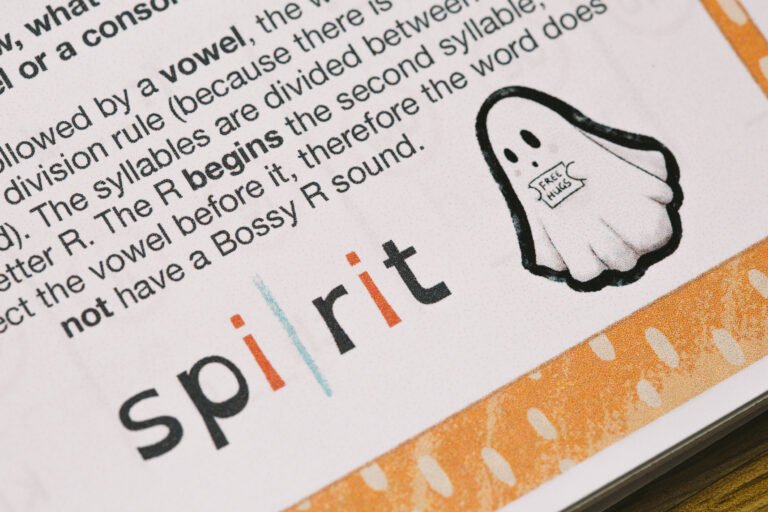
Why is the word “very” split as ver-y but doesn’t have a controlled r?
Why do we split “many” as man-y, but pronounce it as “ma–ny“?
The answer “because it’s an exception” is not a good reason.
What if none of those words are an exception?
And the the method being used is actually wrong ?
Just as bloodletting was ineffective in curing disease, the traditional syllable division method is equally ineffective, and confusing, when vowel length is treated as the determining factor of what a syllable is.
BUT, if syllables are determined according to the cadence of speech, almost all of the exceptions disappear.
The syllable boundary needs to be determined by the number of different consonant sounds between the vowels, so that it matches pronunciation boundaries.
When you base syllable division on the number of different consonants between the vowels, you get a consistent and accurate framework that has almost no exceptions.
Then you’ll ask:
“But what about spelling? How do we handle double letters in spelling?”
Yes, syllable division helps break words into smaller chunks. But it only reflects how the syllable is formed around a vowel sound. Syllables do not determine how many letters make up the syllable, but how that part of the word is pronounced, so it would not tell you whether a word contains a double letter.
English spelling is a complex beast that relies on rules, sound patterns, and memorisation. There is just no way around all three, and so spelling should be treated differently to reading.
When learning to spell, if you ask your first grader to spell the word “robin” by just listening to the word, if they were using the currently accepted method they’d split it as “rob-bin.” But the word isn’t spelled with a double b. It’s as if your child needs to already know whether a word contains a double letter before they can split it into syllables. Confusing, right?
It’s a common misconception that words with a short vowel automatically contain double letters. Far fewer words actually contain double letters than people assume, and regardless of how you split the syllables, your child will still have to either understand the mechanic behind why the double letter occurs, or memorise the words that do contain a double letter. Whatever effective technique you use to memorise the way the word is spelled is the one to go with, but it should not rely on syllable division to tell you that a double letter occurs in the word, because the method would garner inconsistent results.
You cannot use syllable division to teach a child where the double letter occurs — the logic is circular, because your child must already know the letter is doubled in the word before they can even attempt to split it into syllables...
want to see Another flipthrough?